











































In short: RFID wristbands are contactless credentials worn on the wrist. A small chip and antenna sit inside a silicone or woven fabric band, so the wearer can open a locker, go through a door or gate and pay at a bar with a tap. They suit wet, busy or hands-full places such as leisure centres, spas, festivals and hotels. The one rule that matters most: the chip in the band must match the readers or locks you already use.
This guide explains how RFID wristbands work, where they are used, how they compare with cards and key fobs plus what to check before you order.
What is an RFID wristband?
An RFID wristband is a band with a radio frequency identification chip and antenna built into it. When the band is held close to a compatible reader, the reader powers the chip and reads the data on it.
Most RFID wristbands use one of two frequencies:
- 13.56MHz (high frequency). This covers the MIFARE family, including MIFARE Classic 1K and MIFARE DESFire, as well as NFC-type chips such as NTAG213. These chips follow the ISO 14443 standard and can store data as well as an ID number.
- 125kHz (low frequency). Older proximity systems often use chips such as EM4200. These typically carry a fixed ID number and little else.
A 13.56MHz reader will not read a 125kHz band, nor the other way round. If you are unsure which your system uses, our guide to proximity vs MIFARE vs DESFire explains the differences.
Where are RFID wristbands used?
Anywhere people need a credential they cannot easily drop, lose or get wet, a wristband tends to work better than a card. Common settings include:
- Leisure centres, gyms and swimming pools. A contactless wristband opens a changing room locker and can stay on in the pool.
- Spas and hotels. Guests can use one band for their room, the spa and on-site spending where the venue's system supports it.
- Festivals, concerts and conferences. Event wristbands speed up gate checks and can carry a cashless balance.
- Campuses and workplaces. Staff in wet or hands-busy roles can tap through doors without reaching for a pocket.
For example, a leisure centre might issue a silicone RFID wristband at reception, let the member use it for their locker during a swim, then collect it, re-encode it and hand it to the next visitor.
Why choose a wristband over a card or key fob?
Wristbands are hands free, hard to lose and well suited to wet areas. Cards are better for printed photo ID. Key fobs sit neatly on a keyring.
| Feature | RFID wristband | ID card | Key fob |
|---|---|---|---|
| How it is carried | Worn on the wrist | Wallet, lanyard or holder | Keyring |
| Hands free | Yes | Only on a lanyard or reel | No |
| Wet areas such as pools | Silicone bands are designed for it | Not ideal | Depends on the fob |
| Printed photo ID | No | Yes | No |
| Branding | Logo or text on the band | Full colour print on both sides | Limited |
| Typical use | Lockers, leisure, events, hospitality | Staff and student ID with access | Doors and offices |
Many sites use a mix. For more on cards and fobs, read access control cards and fobs explained.
Will an RFID wristband work with my access control system?
Only if the chip in the band matches what your readers and locks expect. An access control wristband is simply another credential, so it needs the same chip type, the same frequency and the correct encoding as your existing cards or fobs.
Check three things before you buy:
- The chip. MIFARE Classic 1K, MIFARE DESFire EV2 and NTAG213 are different chips. A system set up for one may not accept another.
- The frequency. 13.56MHz and 125kHz systems are not interchangeable.
- The system. Some lock systems need credentials made for them.
Salto is a good example. The Salto key cards, key fobs and wristbands we list include a MIFARE 1K silicone wristband described as compatible with SALTO Virtual Network data-on-card technology. There is also a Salto DESFire EV2 silicone wristband made for use with SALTO Space systems. If your site already runs Salto cards, choose wristbands with the same chip family so they work on your existing locks.
Not sure? Tell us your reader or lock system and we will confirm compatibility before you order.
Silicone or fabric event wristbands: which is right?
Silicone RFID wristbands are reusable and built for repeat daily use. Woven fabric event wristbands are fitted once and worn for a single event.
Silicone RFID wristbands
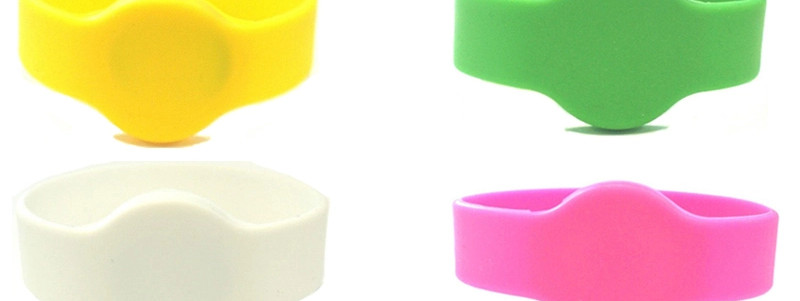
Our NXP MIFARE Classic 1K silicone wristbands have the chip sealed inside the silicone. The product is described as waterproof, durable, scratch resistant and tear resistant. Bands can be cleaned, re-encoded and reissued to a new user. That makes a MIFARE wristband a popular choice for leisure facilities, keyless lockers and cashless vending. They come in a choice of colours and can be branded with a logo or text.
Fabric event wristbands
Our branded wristbands for events are woven fabric with a contactless card fitted to the band. A one-way plastic barrel fastener tightens and will not loosen, so the band cannot be removed intact and passed to someone else. It has to be cut off. Chip options include MIFARE Classic 1K, MIFARE DESFire, MIFARE Ultralight, NTAG213 and ICODE SLIX. Bands can be pre-encoded before delivery. The band itself can carry logos, event colours, icons, sequential numbering and UV colour options.
These bands can be worn across several days of one event. They can only be encoded once, though. If you need to collect and reissue the same credential session after session, silicone is the better fit.
Can RFID wristbands be used for cashless payments?
Yes, where your payment or event platform supports the chip. A contactless wristband can hold a balance topped up before the event, so guests tap to buy at bars and stalls. Payment depends entirely on the system you use, so confirm compatibility first. For wider event planning ideas, see our post on low-cost solutions for your next event.
Are RFID wristbands secure?
An RFID wristband is as secure as the chip and the system behind it. A band adds convenience. It does not add security on its own. MIFARE DESFire chips are generally chosen where stronger security is needed than older MIFARE Classic or 125kHz proximity credentials can offer. Fabric event bands also help stop entry passes being shared, because the fastener cannot be undone without cutting the band.
Tips on hygiene and sizing
- Clean reusable bands between users. Silicone can be wiped down. Follow your venue's own hygiene procedure.
- Check the size. Some wristbands are sold in specific sizes, such as medium. Think about who will wear them, including children.
- Test before rollout. Try a sample band on your readers and lockers before ordering for the whole site.
Choosing RFID wristbands starts with one question: what chip does your system read? Get in touch with the team about your system and how the bands will be used. We will help you find the right wristband.
Frequently asked questions
What is a MIFARE wristband?
A MIFARE wristband is an RFID wristband containing a MIFARE chip, such as MIFARE Classic 1K or MIFARE DESFire. It works at 13.56MHz with MIFARE readers and locks.
Are RFID wristbands waterproof?
Silicone RFID wristbands are designed for wet environments, with the chip sealed inside the band. That is why they are widely used in swimming pools and spas. Check the details of the specific product before relying on it underwater.
Do Salto wristbands work with any Salto system?
Not automatically. Salto wristbands come with different chips, such as MIFARE 1K or DESFire EV2. Choose the chip your Salto system is set up to read.
Can RFID wristbands be reused?
Silicone wristbands can be cleaned, re-encoded and reissued. Woven fabric event wristbands with a one-way fastener are made for a single event and can only be encoded once.
Can event wristbands be branded?
Yes. Fabric event wristbands can carry logos, colours, icons, sequential numbering and UV colour options. Silicone wristbands can be branded with a logo or text.
Will a 125kHz wristband work on a MIFARE reader?
No. 125kHz proximity and 13.56MHz MIFARE use different frequencies. A reader built for one will not read the other unless it is a dual-frequency reader.