

































Most access cards and key fobs look alike from the outside. The outside tells you very little about the chip inside. That chip decides whether a replacement will open your doors. This guide explains the three technologies we are asked about most often (125kHz proximity, MIFARE Classic and MIFARE DESFire) along with a few close relatives. It also shows how to work out which one you already have.
Two frequencies, very different cards
Most contactless access cards and fobs in UK buildings work at one of two radio frequencies. Low frequency cards run at 125kHz. High frequency cards run at 13.56MHz. A reader built for one frequency will not see a card built for the other, so the frequency is the first thing to pin down.
125kHz proximity cards and fobs
Proximity (often shortened to prox) is the older technology. A typical prox card holds a fixed ID number written at the factory. When you present it, the reader picks up that number and passes it to the access control system, which decides whether to open the door. There is no encryption on most prox cards. The number can be read at short range by anyone with suitable equipment, which is why prox cards are easy to copy.
Common families include EM cards such as the EM4200 printable white card and the matching EM4200 fob. HID Prox is another, for example the HID 1386 ISOProx II card and the HID 1346 ProxKey III fob. These families share a frequency but not a data format. An HID Prox reader expects HID data, so a generic EM card will not simply drop into an HID system.
MIFARE Classic
MIFARE Classic works at 13.56MHz under the ISO/IEC 14443 standard. It comes in two memory sizes, 1K and 4K. The cards can store data in protected sectors as well as a unique serial number. That made Classic popular for access control, vending and libraries.
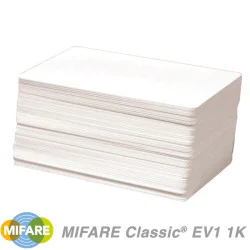
The weak point is its security. MIFARE Classic uses a proprietary encryption scheme that researchers broke many years ago. It still works in many buildings. It is no longer the recommended choice for a new installation where security matters. Examples in our range include NXP MIFARE Classic 1K EV1 cards (MF1ICS50), MIFARE Classic 4K EV1 cards and NXP MIFARE 1K key fobs.
MIFARE DESFire
DESFire also runs at 13.56MHz on ISO/IEC 14443. It was designed with security at its heart. EV1, EV2 and EV3 support AES encryption, which is far stronger than the scheme used by Classic. DESFire can also hold several separate applications on one card, so access control and printing or vending can live side by side. Our range includes DESFire EV2 4K cards (MF3D4201DUD) plus DESFire EV3 8K cards (DS8KEV3).
Other types you may come across
- MIFARE Ultralight is a low cost 13.56MHz chip with a small memory, used for event passes and short life tickets. See the MIFARE Ultralight EV1 cards.
- HID iCLASS is a 13.56MHz family from HID with its own security model. An example is the HID iCLASS 2K/2 printable card.
- Dual technology cards carry a 125kHz chip plus a 13.56MHz chip in one card. They help sites that are moving from prox to smart readers. Try the EM4200 with MIFARE 1K dual card or the HID 2124 iCLASS with Prox card.
- Contact chip cards have a gold contact plate on the surface. They must be inserted into a slot reader instead of being waved at one. The Infineon SLE 5542 card is a typical memory chip card.
Comparison at a glance
| Technology | Frequency | Security | Typical use | Plastic-ID examples |
|---|---|---|---|---|
| Proximity (EM, HID Prox) | 125kHz | ID number only, no encryption | Door entry on older systems | EM cards, HID cards and tags |
| MIFARE Classic 1K / 4K | 13.56MHz | Proprietary encryption, now considered broken | Access, vending, libraries | MIFARE cards |
| MIFARE DESFire EV1 / EV2 / EV3 | 13.56MHz | AES encryption, much stronger | New or upgraded access systems | DESFire EV3 8K |
| MIFARE Ultralight | 13.56MHz | Basic | Events, short life passes | Ultralight EV1 |
| HID iCLASS | 13.56MHz | HID security model | HID access systems | HID cards and tags |
| Dual technology | 125kHz plus 13.56MHz | As each chip | Migrating between systems | EM4200 with MIFARE 1K |
| Contact chip | None (contact plate) | Depends on chip | Slot readers | Contact chip cards |
How to tell which one you have
- Look for printing. Many cards carry a maker logo or a part number on the back or edge. A brand such as HID, Paxton or Salto narrows things down quickly.
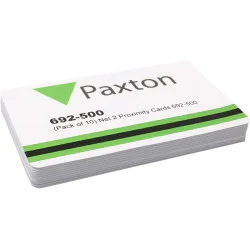
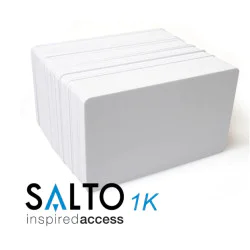
- Ask your access control system. The software or the controller usually names the reader type. Paxton users can check our Paxton fobs page, which has a table matching each Paxton system to the right fob. Card users can see Paxton cards. Salto sites can visit Salto cards.
- Try an NFC phone. Most smartphones with NFC can detect a 13.56MHz card using a free chip reading app. If the phone sees nothing at all, the card may well be 125kHz, because phones cannot read that frequency.
- Hold a white card up to a bright light. On thin cards you can sometimes see the antenna. Prox coils are often small with many turns. 13.56MHz antennas often run around the edge of the card. Treat this as a clue only.
Frequently asked questions
Can I use a MIFARE card on a 125kHz reader?
No. The frequencies differ, so the reader will not detect it. A dual technology card is the usual answer when both types of reader are in use.
Is MIFARE Classic still safe to use?
It still works on many sites. Its encryption is known to be weak though, so we suggest DESFire for new systems where security matters.
Will any EM card work on my prox system?
Not always. Many systems also check a site code or card format, so the card may need to be programmed to match.
Why will my phone not read my fob?
Phones read 13.56MHz only. A 125kHz fob will not respond to a phone at all.
Not sure? Send us a card or a photo
If you are still unsure, we will identify it for you. Email a clear photo of the front and back of your card or fob (plus any numbers printed on it) to sales@plastic-id.com. You can also call us on 0203 744 2333 to arrange posting a sample card. We will confirm the technology then point you to matching cards or key fobs from our range.